
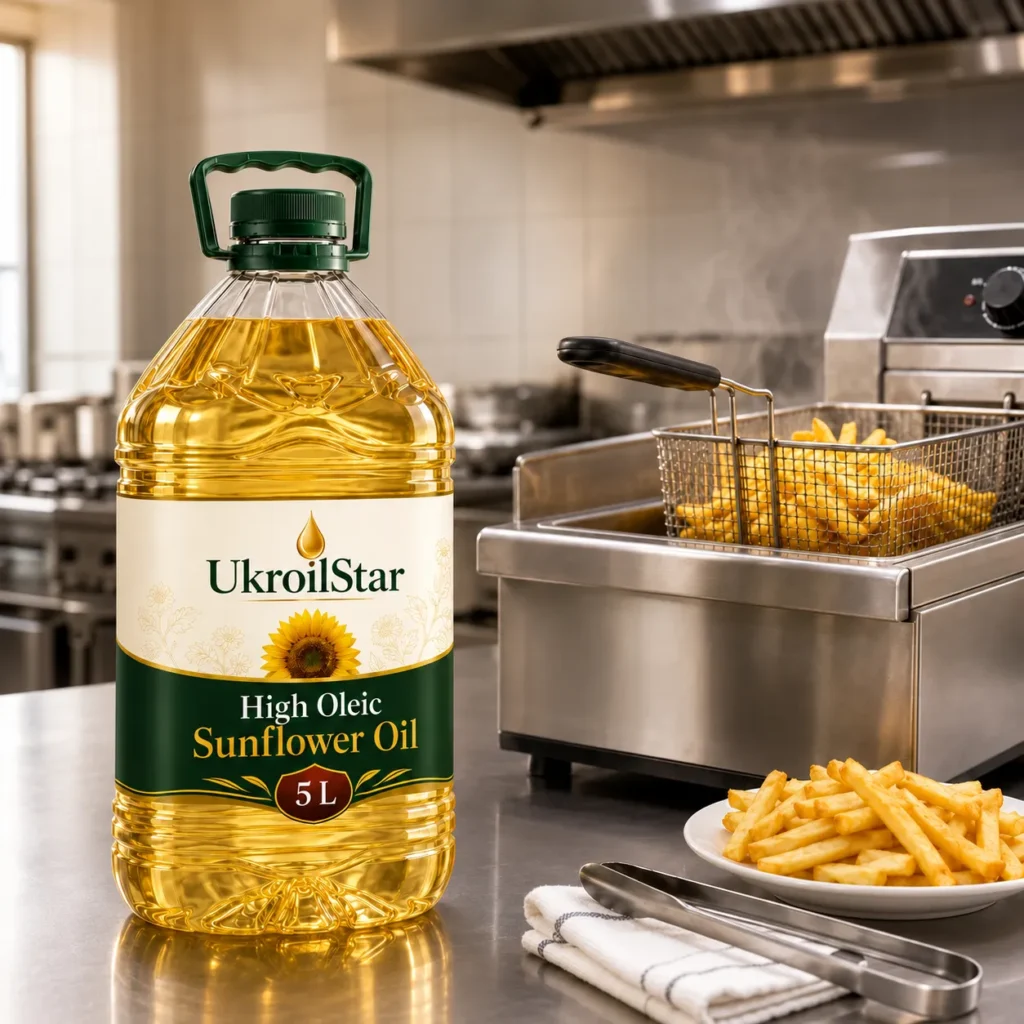
Top Oils for Deep Frying: Best Cooking Oils, Benefits, Temperatures & Buying Guide


Choosing the right oil for deep frying can make the difference between crisp, golden food and a greasy, disappointing meal. Whether you’re preparing French fries at home, cooking chicken in a restaurant, or purchasing frying oil for a commercial kitchen, the oil you select affects flavor, texture, stability, and operating costs.
The top oils for deep frying are generally those with suitable heat stability, a flavor profile that complements the food, and consistent quality under the intended cooking conditions.
Popular choices include high-oleic sunflower oil, refined sunflower oil, refined peanut oil, canola oil, rice bran oil, and certain refined olive oils.
However, not all oils perform equally during prolonged heating. Their fatty-acid composition, degree of refining, and resistance to oxidation can significantly affect frying performance.
In this guide, we compare the best cooking oils for deep frying, explain how to select the right oil, and explore what restaurants and wholesale buyers should consider when sourcing Ukrainian sunflower oil.
What Makes an Oil Good for Deep Frying?
Deep frying typically involves cooking food in hot oil at temperatures of approximately 160–190°C (320–375°F), depending on the recipe.
At these temperatures, the oil transfers heat rapidly to the food, helping create a crisp exterior while the interior cooks.
A suitable frying oil should offer several important characteristics.
Heat and Oxidative Stability
During frying, oil is exposed to heat, oxygen, moisture, and food particles. These conditions can cause chemical changes that gradually reduce oil quality.
Oils with higher oxidative stability are generally better suited to prolonged commercial frying.
Fatty-acid composition matters because polyunsaturated fatty acids are typically more susceptible to oxidation than monounsaturated fatty acids.
Suitable Smoke Point
The smoke point is the temperature at which an oil begins producing visible smoke under specified conditions.
It can help indicate whether an oil is appropriate for a cooking temperature, but it is not the only measure of frying performance.
An oil with a high smoke point may still deteriorate during repeated or prolonged heating.
Neutral Flavor
Many restaurants prefer neutral-flavored frying oils because they allow the natural flavor of chicken, fish, potatoes, and other foods to remain prominent.
Refined deodorized sunflower oil is popular for this reason.
Cost and Availability
For commercial kitchens, oil cost affects operating expenses.
However, the cheapest oil per liter is not always the most economical option if it deteriorates rapidly or requires more frequent replacement.
Top 6 Oils for Deep Frying

1. High-Oleic Sunflower Oil
High-oleic sunflower oil contains a higher proportion of monounsaturated oleic acid than conventional sunflower oil. Its fatty-acid composition generally makes it more resistant to oxidation, which is particularly useful in demanding commercial frying applications.
Best for: Restaurants, French fries, fried chicken, food manufacturing and commercial fryers.

2. Refined Sunflower Oil
Refined sunflower oil offers a mild flavor and is widely used for household cooking and foodservice. Conventional high-linoleic grades can work for frying, but are generally less oxidatively stable than high-oleic varieties.
Best for: General-purpose frying, household cooking and suitable short-duration frying applications.

3. Canola Oil
Refined canola oil is commonly used for frying because of its relatively neutral taste and favorable unsaturated fat composition. High-oleic canola varieties are also available for commercial applications.
Best for: General frying, restaurants, and food preparation.

4. Refined Peanut Oil
Refined peanut oil is often selected for deep frying because of its cooking performance and relatively mild flavor. Its suitability depends on refining and product quality.
Best for: Fried chicken, Asian-inspired dishes, and restaurant frying. Food businesses must consider applicable allergen rules.

5. Rice Bran Oil
Rice bran oil contains a mixture of fatty acids and naturally occurring minor components. Refined versions are used for frying in various cuisines.
Best for: Stir-frying, deep frying and commercial cooking where suitable specifications are available.

6. Refined Olive Oil
Refined olive oil can be used for frying and contains predominantly monounsaturated fatty acids. Its cost and flavor profile may make it less attractive for some high-volume foodservice operations.
Best for: Household frying, sautéing and recipes where olive oil is preferred.
Best Oils for Deep Frying: Comparison Table
| Cooking oil | Typical flavor | Oxidative stability | Common use |
|---|---|---|---|
| High-oleic sunflower | Neutral | Generally high | Commercial frying |
| Refined sunflower | Neutral | Varies by fatty-acid profile | General frying |
| Refined canola | Neutral | Moderate; varies by grade | General frying |
| Refined peanut | Mild | Depends on composition | Deep frying |
| Refined rice bran | Mild | Depends on refining and composition | Frying and stir-frying |
| Refined olive | Mild | Generally good | Home frying |
This comparison is qualitative. Actual performance should be evaluated using product specifications and the intended frying process rather than broad oil categories alone.
Why High-Oleic Sunflower Oil Is Popular for Commercial Frying
High-oleic sunflower oil is frequently considered for commercial frying because of its elevated oleic acid content.
Compared with conventional high-linoleic sunflower oil, it generally has improved oxidative stability during heating.
For restaurants and industrial food processors, this can be an important purchasing consideration.
However, no oil has an unlimited frying life. Frying conditions, filtration, food composition, and oil maintenance affect degradation.
Refined Deodorized Sunflower Oil for Frying
Refining and deodorization reduce impurities and unwanted odors, producing an oil with a relatively neutral flavor.
Refined deodorized sunflower oil can be useful for commercial food preparation where consistent sensory characteristics matter.
Buyers should confirm whether the offered product is conventional, mid-oleic, or high-oleic sunflower oil.
These are different product specifications and should not be treated as interchangeable.
What Temperature Should You Use for Deep Frying?
The appropriate temperature depends on the food, oil grade, fryer design, and cooking process.
Many recipes use temperatures between 160°C and 190°C.
For example, potatoes may be fried at different temperatures depending on whether they are being blanched or finished to achieve a crisp exterior.
Food businesses should use a suitable thermometer or controlled fryer to maintain consistent conditions.
Avoid allowing oil to smoke, and do not assume that hotter oil always produces better results.
How to Keep Frying Oil in Good Condition
Proper handling helps maintain cooking performance.
-
Use a clean fryer and suitable temperature controls.
-
Avoid overheating and excessive exposure to air.
-
Remove burnt food particles.
-
Filter oil when appropriate for the operation.
-
Follow established oil replacement procedures.
-
Never add water directly to hot frying oil.
-
Store unused oil in sealed, food-grade containers away from heat and sunlight.
Commercial operators may monitor oil quality using measurements such as total polar compounds, according to applicable regulations and quality-control procedures.
H2: Technical Details
Selecting frying oil for wholesale purchase requires more than comparing bottle sizes and prices.
Restaurants and food manufacturers should evaluate the technical characteristics of each offered oil.
Important parameters include fatty-acid composition, free fatty acids, peroxide value, moisture, insoluble impurities, and oxidative stability.
Product Specifications Table — Refined Sunflower Oil for Frying
The following table is an illustrative specification framework, not a verified UKROILLSTAR product COA.
| Technical parameter | General description |
|---|---|
| Product | Refined sunflower oil |
| Botanical source | Helianthus annuus |
| Processing | Refined and deodorized |
| Winterization | If specified |
| High-oleic grade | Available as a distinct oil category |
| Appearance | Clear, pale-yellow liquid |
| Taste | Mild or neutral |
| Odor | Neutral |
| Main fatty acids | Oleic and linoleic acids |
| Free fatty acids | Confirm through batch COA |
| Peroxide value | Confirm through batch COA |
| Moisture | Confirm through batch COA |
| Insoluble impurities | Confirm through batch COA |
| Oxidative stability | Grade-dependent |
| Intended use | Cooking, frying and food manufacturing |
| Country of origin | Verify for each shipment |
| Shelf life | Manufacturer-specific |
| Storage | Sealed, cool and protected from light |
For commercial frying, buyers should request the exact fatty-acid profile and applicable laboratory results.
H3: Packaging Information


Sunflower oil is distributed in different packaging formats depending on market requirements.
| Packaging size | Packaging type | Typical buyer |
|---|---|---|
| 850 ml | PET bottle | Retail distributors |
| 1 L | PET bottle | Household consumers |
| 1.5 L | PET bottle | Supermarkets |
| 3 L | PET bottle | Family households |
| 5 L | PET bottle | Retail and foodservice |
| 10 L | Jerrycan | Restaurants |
| 20 L | Food-grade jerrycan | Catering and commercial kitchens |
| Bulk | Flexitank or other suitable container | Food manufacturers |
Packaging formats are illustrative and require supplier confirmation.
Private-Label Frying Oil
Private-label sunflower oil can support distributors seeking products under their own brand names.
Depending on manufacturing capability, options may include custom labels, carton designs, and market-specific packaging.
Minimum order quantities, label approvals, and production lead times should be agreed before ordering.
Buy Ukrainian Sunflower Oil for Deep Frying
Ukraine has an established sunflower cultivation and processing industry and is a relevant sourcing market for edible oil importers.
Businesses searching for Ukrainian sunflower oil suppliers, bulk refined sunflower oil, and sunflower oil exporters from Ukraine should evaluate documented product quality, origin, packaging, and shipping arrangements.
UKROILLSTAR’s website, ukroillstar.com, provides a starting point for product inquiries.
Wholesale Sunflower Oil for Restaurants and Distributors
Restaurants and distributors often prioritize consistent specifications, practical packaging, and competitive landed costs.
A quotation request should identify the required oil grade, packaging format, quantity, delivery destination, and preferred Incoterm.
For high-volume frying, request high-oleic sunflower oil specifically if its stability characteristics are needed.
FOB and CIF Sunflower Oil Quotations
FOB and CIF are commonly used international trade terms for sea shipments.
Under FOB, the seller delivers goods on board the vessel at the named port of shipment.
Under CIF, the seller arranges and pays for freight and the required insurance coverage to the named destination port, while risk transfers when the goods are loaded on board at the shipment port.
Commercial quotations should identify the agreed Incoterms edition, shipment size, destination, and validity period.
Best Frying Oil for Turkey: Kızartmalık Ayçiçek Yağı
Turkey is a relevant market for sunflower oil products, including household cooking oil and foodservice frying oil.
Turkish-language search phrases include:
-
Kızartmalık ayçiçek yağı — Sunflower oil for frying
-
Ukrayna ayçiçek yağı — Ukrainian sunflower oil
-
Toptan ayçiçek yağı — Wholesale sunflower oil
-
Rafine ayçiçek yağı — Refined sunflower oil
-
Yüksek oleik ayçiçek yağı — High-oleic sunflower oil
-
Ukrayna’dan ayçiçek yağı ithalatı — Importing sunflower oil from Ukraine
Ukrayna Menşeli Kızartmalık Ayçiçek Yağı
Restoranlar, oteller ve gıda üreticileri için doğru kızartmalık yağ seçimi, ürün kalitesi ve pişirme performansı açısından önemlidir. Yüksek oleik ayçiçek yağı, oksidatif dayanıklılığı nedeniyle yoğun kızartma uygulamalarında tercih edilebilir. Ukrayna menşeli rafine ayçiçek yağı için toptan fiyat, ambalaj, analiz belgesi ve teslim koşulları hakkında UKROILLSTAR üzerinden teklif talep edebilirsiniz.
For a Turkish audience, create a dedicated Turkish-language article rather than relying solely on translated keyword phrases inside an English page.
Frequently Asked Questions
What is the best oil for deep frying?
High-oleic sunflower oil, suitable refined canola oil, refined peanut oil, and other stable refined oils can be good choices. The best option depends on cooking conditions, availability, price, and product specifications.
Is sunflower oil suitable for deep frying?
Yes. Refined sunflower oil can be suitable for deep frying, while high-oleic grades are often preferred for more demanding frying conditions.
Can you reuse sunflower oil after frying?
Reuse depends on oil condition, handling, and applicable food-safety requirements. Oil showing signs of significant degradation should be discarded.
Is high-oleic sunflower oil better than regular sunflower oil?
For prolonged high-temperature frying, high-oleic sunflower oil generally offers better oxidative stability than conventional high-linoleic sunflower oil.
Where can I buy sunflower oil for restaurants?
Restaurants can source suitable sunflower oil through edible oil wholesalers, foodservice distributors, and verified suppliers offering commercial packaging.
Conclusion: Choosing the Top Oils for Deep Frying
The top oils for deep frying combine suitable heat stability, acceptable flavor, consistent quality, and practical purchasing costs.
High-oleic sunflower oil is an attractive option for many commercial frying applications, while conventional refined sunflower oil remains useful for general cooking and suitable frying processes.
For restaurants, food manufacturers, and distributors, selecting the correct oil grade and reviewing verified specifications are essential.
To explore Ukrainian sunflower oil sourcing options, visit UKROILLSTAR and request information about refined sunflower oil, packaging, technical specifications, and wholesale quotations.
