
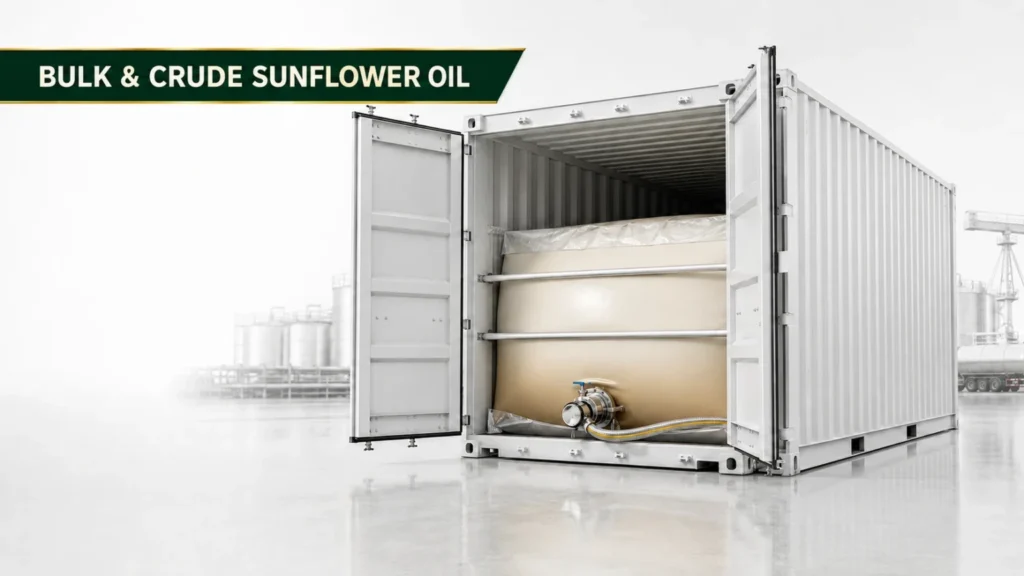
Bulk Flexitank vs PET Bottles: Choosing the Best Sunflower Oil Packaging for Wholesale & Export


When importing sunflower oil, choosing the right packaging is just as important as selecting the right supplier. Packaging affects transportation costs, product handling, storage requirements, distribution, and ultimately your profit margins.
For international buyers, one of the most important decisions is bulk flexitank vs PET bottles.
Should you import refined sunflower oil in a large flexitank and bottle it locally, or purchase ready-to-sell sunflower oil in PET bottles directly from the exporter?
The answer depends on your business model, destination market, order quantity, and available infrastructure.
At UKROILLSTAR, prospective buyers can explore sunflower oil products and request commercial information for their preferred packaging and export requirements.
This guide explains the differences between flexitank and PET bottle packaging, their advantages, technical considerations, and how to choose the most suitable option for your sunflower oil business.
What Is Bulk Sunflower Oil Packaging in a Flexitank?


A flexitank is a flexible liquid container installed inside a suitable freight container to transport compatible non-hazardous liquids.
For sunflower oil exporters, flexitanks can provide an alternative to shipping large quantities of oil in individual bottles or drums.
A typical food-grade flexitank system includes a flexible liner, filling and discharge valves, restraining equipment, and a compatible shipping container.
According to the Container Owners Association, flexitanks are commonly designed for single-use transport, usually in 20-foot general-purpose containers. The association identifies a maximum of 24,000 kg and usually 24,000 liters for standard systems, subject to equipment and operating requirements.
The actual permitted sunflower oil load depends on the flexitank manufacturer’s limits, container payload, route restrictions, cargo density, and carrier approval.
Advantages of Bulk Sunflower Oil Flexitanks
Reduced retail packaging requirements: Bulk shipments avoid the need to purchase, fill, label, and carton thousands of individual bottles before export.
Suitable for industrial buyers: Food processors, refiners, and local bottling facilities can receive large quantities of sunflower oil for further processing or packaging.
Potential freight efficiency: A suitable flexitank may carry more liquid per container than some packaged configurations, although this must be verified for each shipment.
Local branding flexibility: Importers with their own filling lines can bottle sunflower oil under locally developed brands.
Simplified bulk receiving: Businesses equipped with suitable pumps, hoses, tanks, and quality-control systems can integrate bulk oil into their production operations.
Disadvantages of Flexitank Shipping
Flexitanks are not suitable for every importer.
The destination facility must be capable of receiving and handling bulk edible oil safely.
A damaged flexitank or incorrect installation can lead to serious leakage, contamination, and cargo losses.
Other considerations include equipment approval, unloading procedures, temperature conditions, insurance arrangements, and disposal of the used liner.
Flexitanks should not be treated as automatically cheaper or safer than bottled shipments.
What Are PET Bottles for Sunflower Oil Packaging?


PET stands for polyethylene terephthalate, a plastic material commonly used to manufacture food and beverage containers.
For sunflower oil, PET bottles provide a convenient packaging format for retail, wholesale, and foodservice markets.
Common bottle capacities include 850 ml, 1 L, 1.5 L, 2 L, 3 L, and 5 L, with larger containers available depending on manufacturing capability.
PET bottles are generally lightweight, easy to handle, and suitable for printed labels and retail presentation.
Advantages of PET Bottled Sunflower Oil
Ready for retail distribution: Bottled sunflower oil can be supplied in consumer-friendly sizes, reducing the need for importers to establish local filling operations.
Private-label opportunities: Importers may request custom branding, subject to supplier production capabilities and agreed order quantities.
Convenient inventory management: Individual bottles and cartons can be distributed to supermarkets, grocery stores, restaurants, and wholesalers.
Multiple product sizes: Buyers can select packaging suited to local customer preferences.
Controlled retail portions: Sealed bottles provide convenient handling and help protect the product when correctly manufactured and stored.
Disadvantages of PET Bottle Packaging
Bottled sunflower oil requires additional packaging materials, filling operations, labels, closures, cartons, and handling.
These costs may increase the price per metric ton compared with bulk supply.
Bottled cargo also occupies space differently from bulk liquid shipments, so freight efficiency depends on bottle geometry, carton configuration, pallets, and container limits.
Bulk Flexitank vs PET Bottles: Main Differences
| Comparison | Bulk flexitank | PET bottles |
|---|---|---|
| Primary use | Industrial and bulk distribution | Retail and foodservice |
| Packaging format | Large flexible liquid liner | Individual plastic bottles |
| Typical container | Approved 20-ft dry container | 20-ft or 40-ft container |
| Retail readiness | Requires further packaging | Usually ready for distribution |
| Private labeling | Typically completed after import | May be completed before export |
| Local bottling equipment | Usually required for retail resale | Not required |
| Packaging material per liter | Often lower | Generally higher |
| Unloading | Pumps and compatible receiving equipment | Carton or pallet handling |
| Main risk | Large-volume leakage or contamination | Bottle damage and multiple-unit leakage |
| Best suited to | Bottlers and industrial buyers | Importers, retailers, distributors |
Neither packaging method is universally superior. The correct choice depends on the buyer’s operations and destination-market requirements.
Which Packaging Is More Cost-Effective?
Cost is often the deciding factor when comparing bulk flexitank and PET bottle shipments.
However, buyers should evaluate the complete landed cost instead of comparing only the supplier’s unit price.
For flexitank shipments, relevant costs include the oil itself, flexitank equipment, loading, freight, insurance, unloading, local storage, bottling, labels, and distribution.
For PET bottle shipments, relevant costs include oil, bottles, caps, labels, cartons, filling, palletization, freight, insurance, and destination handling.
Understanding Cost Per Liter
A useful comparison is:
Total landed cost per liter = total relevant landed and processing costs ÷ saleable liters
For a fair comparison, use the same destination, quality grade, shipment period, currency, and final packaging specification.
Bulk flexitanks may offer cost advantages for buyers with established bottling facilities, while PET bottles can be more practical for importers who need a ready-to-distribute product.
H2: Technical Details
Both flexitank and PET bottle shipments must preserve the quality and safety of edible sunflower oil.
Commercial buyers should review the oil specification, packaging materials, container condition, and relevant food-contact requirements.
Product Specifications Table — Refined Sunflower Oil
The following table is a general procurement reference, not a verified UKROILLSTAR batch specification.
| Technical parameter | General description |
|---|---|
| Product | Refined sunflower oil |
| Botanical source | Helianthus annuus |
| Processing | Refined; deodorized when specified |
| Winterization | When required |
| Appearance | Clear, pale-yellow to golden liquid |
| Odor | Mild or neutral |
| Fat content | Approximately 100% |
| Main fatty acids | Oleic and linoleic acids |
| Free fatty acid content | Verify with COA |
| Peroxide value | Verify with COA |
| Moisture and volatile matter | Verify with COA |
| Insoluble impurities | Verify with COA |
| Storage | Protected from excessive heat and sunlight |
| Shelf life | According to manufacturer specification |
| Origin | Verified by shipment documentation |
| Intended application | Food processing, retail, cooking |
Exact chemical limits and product grades must be agreed before shipment.
Flexitank Technical Considerations
Flexitank equipment should be compatible with edible sunflower oil and approved for the proposed transport arrangement.
The Container Owners Association emphasizes that flexitank transport requires consideration of the complete system, including the container, fittings, restraints, cargo compatibility, and operating conditions.
Buyers should confirm filling limits, food-contact suitability, installation procedures, unloading methods, and the shipping line’s acceptance.
Packaging Information


Sunflower Oil Packaging Options
| Packaging format | Capacity or size | Suitable buyers |
|---|---|---|
| Flexitank | Equipment-specific bulk capacity | Industrial processors |
| PET bottle | 850 ml | Retail distributors |
| PET bottle | 1 L | Supermarkets |
| PET bottle | 1.5 L | Retail and family use |
| PET bottle | 3 L | Household distribution |
| PET bottle | 5 L | Wholesale and foodservice |
| Jerrycan | 10 L | Restaurants |
| Jerrycan | 20 L | Catering and commercial kitchens |
These are illustrative industry formats. Actual UKROILLSTAR availability, loading configurations, and minimum order quantities require confirmation.
Choosing Between 20-ft and 40-ft Containers
Flexitank shipments generally use approved 20-foot containers, while bottled sunflower oil can be shipped in suitable 20-foot or 40-foot containers.
The choice depends on shipment weight, volume, loading plans, carrier restrictions, and destination requirements.
A 40-foot container does not automatically provide double the allowable cargo weight of a 20-foot container.
For bottled cargo, buyers should request confirmed cartons per pallet, pallets per container, bottles per carton, and total net oil weight.
Why Ukrainian Sunflower Oil Is Relevant to Global Buyers
Ukraine has an established sunflower cultivation and edible oil processing sector.
International buyers source Ukrainian-origin sunflower oil for retail distribution, industrial food production, private labeling, and wholesale markets.
Businesses searching for Ukraine sunflower oil suppliers, bulk refined sunflower oil, and sunflower oil exporters should evaluate product quality, documentation, packaging, shipment feasibility, and commercial reliability.
At UKROILLSTAR, prospective buyers can submit inquiries describing their preferred packaging and destination requirements.
Sunflower Oil Packaging for the Turkish Market
Turkish buyers commonly search for edible oil using phrases such as:
-
Ukrayna ayçiçek yağı — Ukrainian sunflower oil
-
Toptan ayçiçek yağı — Wholesale sunflower oil
-
Dökme ayçiçek yağı — Bulk sunflower oil
-
Flexitank ayçiçek yağı — Flexitank sunflower oil
-
PET şişe ayçiçek yağı — PET bottled sunflower oil
-
Ukrayna’dan ayçiçek yağı ithalatı — Importing sunflower oil from Ukraine
Ukrayna Ayçiçek Yağı: Flexitank mı PET Şişe mi?
Ukrayna menşeli ayçiçek yağı ithalatında doğru ambalaj seçimi, işletmenin satış modeline ve lojistik ihtiyaçlarına bağlıdır. Dökme ayçiçek yağı için flexitank taşımacılığı, yerel dolum tesisi bulunan ithalatçılar açısından uygun olabilir. PET şişe ayçiçek yağı ise perakende satış ve dağıtım için daha pratik bir seçenek sunabilir.
Turkish-language product and category pages should use accurate translations, market-specific information, and relevant internal links.
How to Request a Sunflower Oil Export Quotation
To compare flexitank and PET bottle pricing, importers should provide:
-
Required sunflower oil grade
-
Total quantity in metric tons
-
Flexitank or PET packaging preference
-
Bottle capacity, if applicable
-
Destination port
-
Preferred Incoterm, such as FOB or CIF
-
Required shipment schedule
-
Applicable certification and labeling requirements
A supplier can then prepare a commercial offer based on the actual order specifications.
For CIF quotations, the destination port and insurance requirements should be clearly identified.
For FOB quotations, the named port of shipment should be confirmed.
Frequently Asked Questions
Is flexitank shipping cheaper than PET bottles?
It can be, particularly for large-volume buyers with local bottling facilities. However, the total cost depends on freight, equipment, handling, storage, and local packaging expenses.
How much sunflower oil fits in a flexitank?
Capacity varies by equipment and transport restrictions. Some systems are designed for up to 24,000 liters or 24,000 kg, but the approved shipment load may be lower.
Are PET bottles suitable for sunflower oil exports?
Yes. Food-grade PET bottles are widely used for edible oil distribution when they meet applicable packaging and food-contact requirements.
Can I import sunflower oil in bulk and bottle it locally?
Yes, provided the importer has suitable food-grade storage, filling equipment, quality-control procedures, and the necessary regulatory approvals.
Which packaging is better for supermarkets?
PET bottles are generally more convenient because they can be delivered in retail-ready sizes.
Conclusion: Bulk Flexitank vs PET Bottles
When comparing bulk flexitank vs PET bottles, the best sunflower oil packaging depends on how your business operates.
Flexitanks are often attractive to industrial processors and importers with local bottling capabilities. PET bottles are generally better suited to retail distributors, supermarkets, and businesses that require finished consumer packaging.
Before ordering, compare total landed costs, product quality, packaging compatibility, delivery terms, and destination-market regulations.
For Ukrainian-origin sunflower oil purchasing inquiries, visit UKROILLSTAR to explore product information and request a wholesale quotation.
Request a quotation: Specify whether you require bulk flexitank or PET bottled sunflower oil, your shipment quantity, and destination port.
